Taking VoiceLK From Model to Product
How VoiceLK integrates its language-processing pipeline, VITS speech synthesis model, frontend, and backend services into a usable application.
T.H. Mihiran Thilakarathna
Taking VoiceLK From Model to Product
Integrating language processing and neural speech synthesis into a practical application.
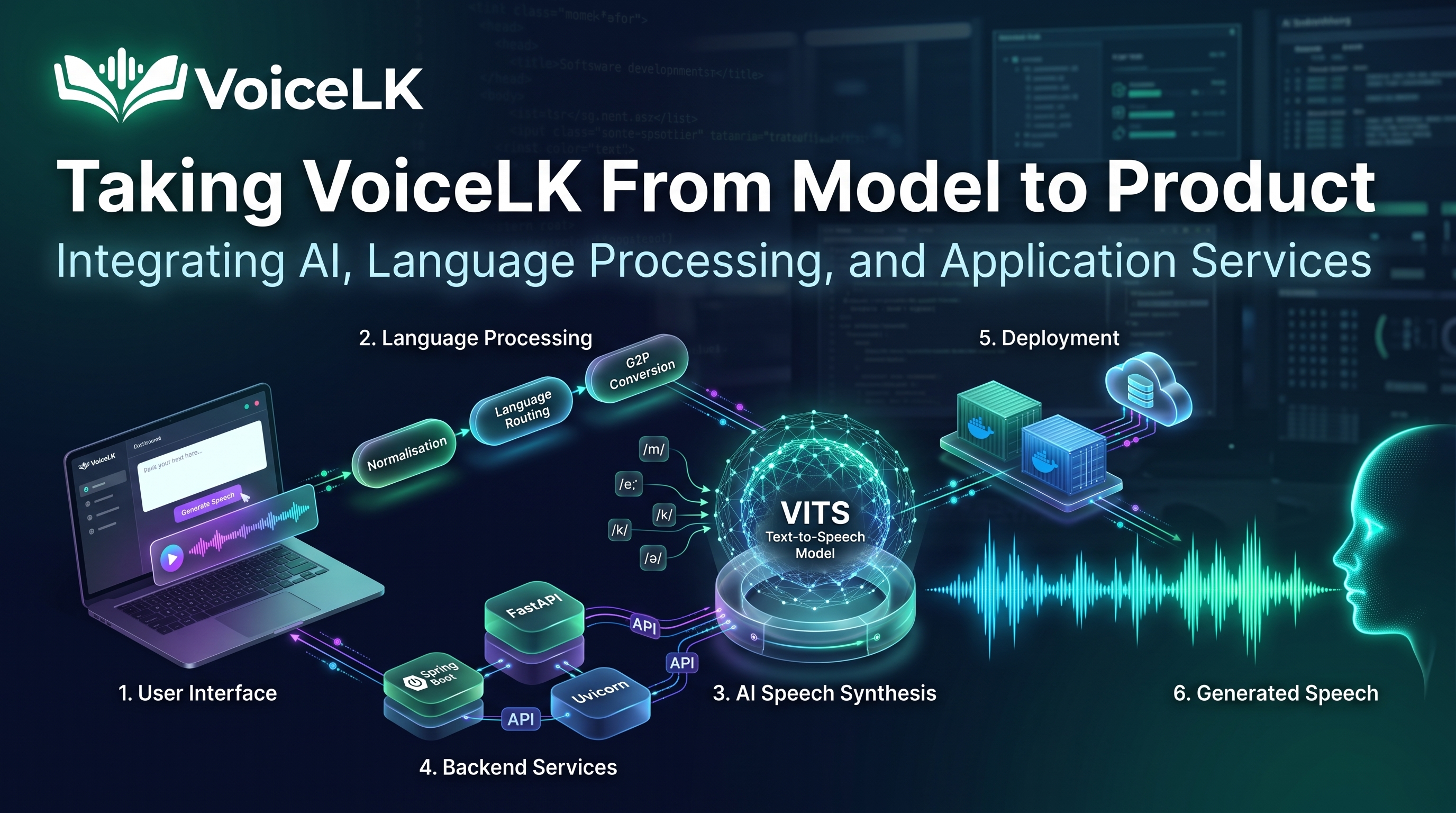
Training a neural text-to-speech model was a major milestone for VoiceLK, but a trained model alone was not enough to deliver a usable solution. We needed to connect the model with the language-processing components and build an application through which users could access its capabilities.
VoiceLK brings together several components: text normalisation, Sinhala–English language routing, custom grapheme-to-phoneme conversion, and neural speech synthesis using the VITS architecture. Together, these components form a pipeline that transforms mixed-language text into generated speech.
To make this pipeline accessible through an application, we developed a software architecture that connects the user interface with the speech-processing backend. The frontend provides the interaction layer, while backend services manage requests and coordinate the processing required to generate speech.
Our technology stack includes React for the frontend, Python with FastAPI and Uvicorn for the speech-processing service, and Java Spring Boot for backend application services. We also use Docker to support deployment and a cloud virtual machine to host the application components.
This integration required more than connecting individual technologies. The components needed to communicate reliably, process input consistently, and work together as a complete system.
By moving from isolated experiments towards an integrated application, we took an important step in making VoiceLK accessible beyond model-training environments.
The goal was not simply to build an AI voice model, but to turn that model into a system people could actually use.