The Problem We Set Out to Solve
Why Sinhala text-to-speech struggles with English technical terms, and how this challenge inspired the beginning of VoiceLK.
T.H. Mihiran Thilakarathna
The Problem We Set Out to Solve
What if technology could speak our language naturally—even when our sentences mix Sinhala and English?
Imagine an Ordinary Level ICT student trying to learn a difficult concept through a digital lesson. The explanation is in Sinhala, but the technical terms are in English.
A sentence might sound like this:
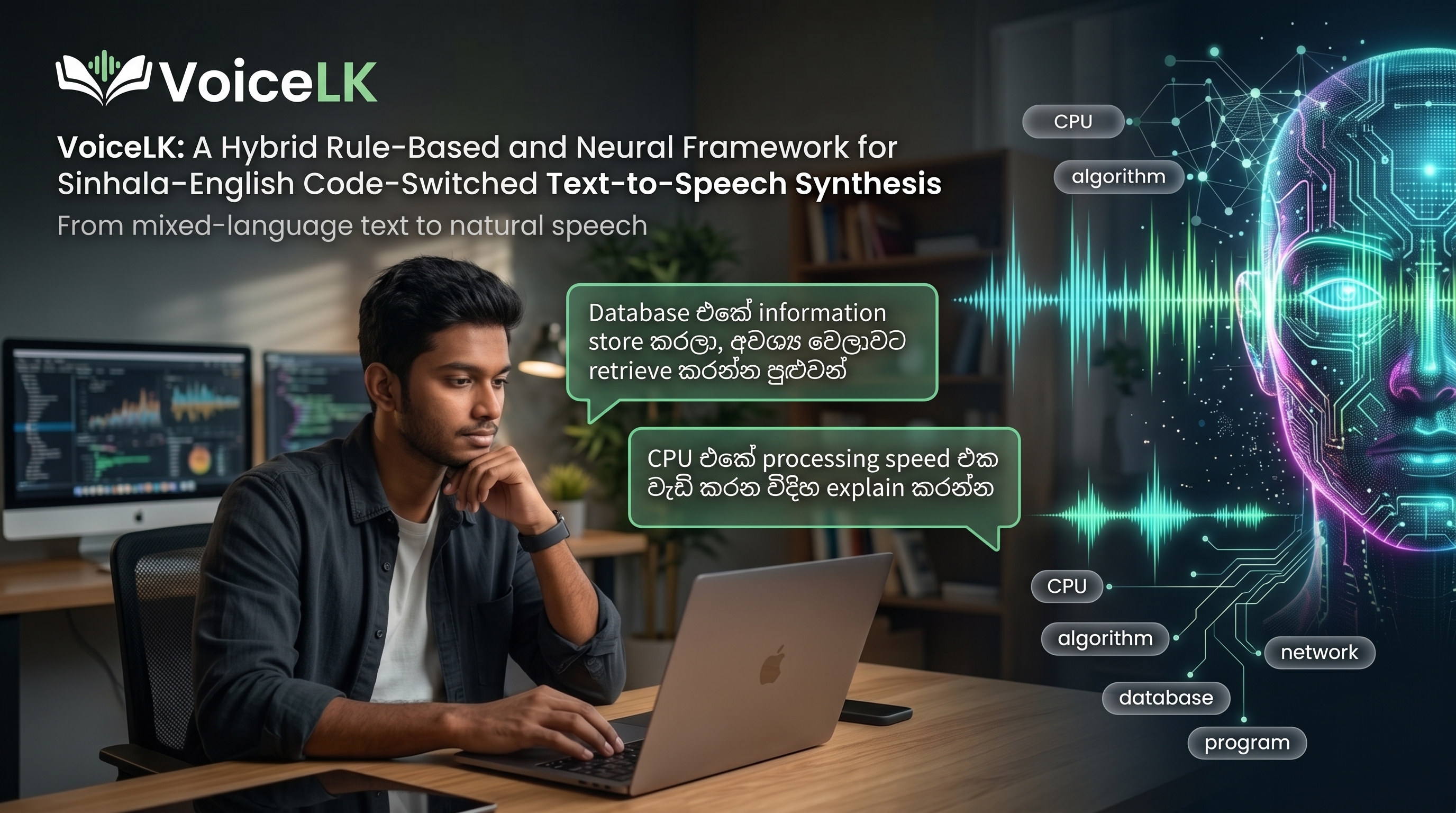
“Database එකක information store කරලා, අවශ්ය වෙලාවට retrieve කරන්න පුළුවන්.”
This is how many Sri Lankan students and teachers naturally communicate when discussing technology. Sinhala provides the explanation, while English carries many of the technical terms. This everyday mixture of languages is known as code-switching.
But what happens when a computer tries to speak these sentences aloud?
When a Sinhala Voice Meets English Technical Terms
Text-to-Speech (TTS) technology converts written text into spoken audio. It can make educational content more accessible, support independent learning, and help students engage with digital lessons.
However, building a voice that can handle Sinhala alone is not the same as building one that can speak Sinhala and English naturally within the same sentence.
Many existing Sinhala TTS systems were designed primarily for Sinhala text. When English technical words, acronyms, numbers, or mixed-language expressions appear in a sentence, pronunciation can become inaccurate or unnatural. The result may sound robotic, interrupt the flow of the explanation, or make technical content harder to understand.
For a student learning ICT, even a single mispronounced technical term can create confusion.
The challenge was not simply to make a computer speak Sinhala. It was to make it understand how Sinhala and English work together in real educational communication.
Why This Problem Matters
In Sri Lankan classrooms, technical subjects frequently introduce concepts using English terminology alongside Sinhala explanations. Students encounter words such as algorithm, database, CPU, and network while learning in Sinhala.
A useful educational voice therefore needs more than basic text-to-speech conversion. It needs to recognise the language of each word, handle technical vocabulary carefully, and produce speech that sounds clear and consistent.
We saw an opportunity to explore how this technology could make digital learning more natural and accessible for Sinhala-speaking students.
The Idea Behind VoiceLK
This challenge became the starting point of VoiceLK—a research project focused on Sinhala–English code-switched Text-to-Speech synthesis.
Rather than relying entirely on pronunciation rules or asking a neural network to solve every language challenge on its own, we explored a hybrid approach. The idea was to combine a rule-based language-processing component, responsible for text normalisation and pronunciation handling, with a neural speech model designed to generate natural-sounding audio.
The goal was straightforward to describe, but challenging to achieve: allow a sentence containing both Sinhala and English to be spoken as one coherent utterance, without awkward language transitions.
This meant investigating pronunciation rules, technical-term dictionaries, mixed-language speech data, neural voice training, and systematic evaluation.
A Problem Became a Product Journey
VoiceLK did not begin with a finished voice or a complete application. It began with a practical question about how Sri Lankan students learn and how technology could better support them.
That question guided our research, shaped our technical decisions, and gave us a clear direction for development.
In the next stage of our journey, we will explore the existing Sinhala voice technologies we investigated, the limitations we identified, and the research gap that helped define the direction of VoiceLK.
This was where our journey began: identifying a real language challenge and asking how we could build a better voice for learning.
VoiceLK — Building a more natural voice for Sinhala–English digital learning.