Turning Experiments Into a Reliable Voice
How VoiceLK’s experimental results helped assess speech intelligibility, pronunciation accuracy, speaker similarity, and generation speed.
T.H. Mihiran Thilakarathna
Turning Experiments Into a Reliable Voice
Using experimental results to improve the consistency, intelligibility, and quality of generated speech.
After identifying the challenges in our early training experiments, we focused on evaluating the results and making targeted improvements to VoiceLK.
A text-to-speech model needs to do more than generate audio. It should pronounce words correctly, produce understandable speech, and maintain consistency when processing Sinhala–English code-switched text.
One important improvement came from extending model training. Our experiments showed that longer training reduced the intelligibility gap by approximately 43%, demonstrating progress towards clearer generated speech.
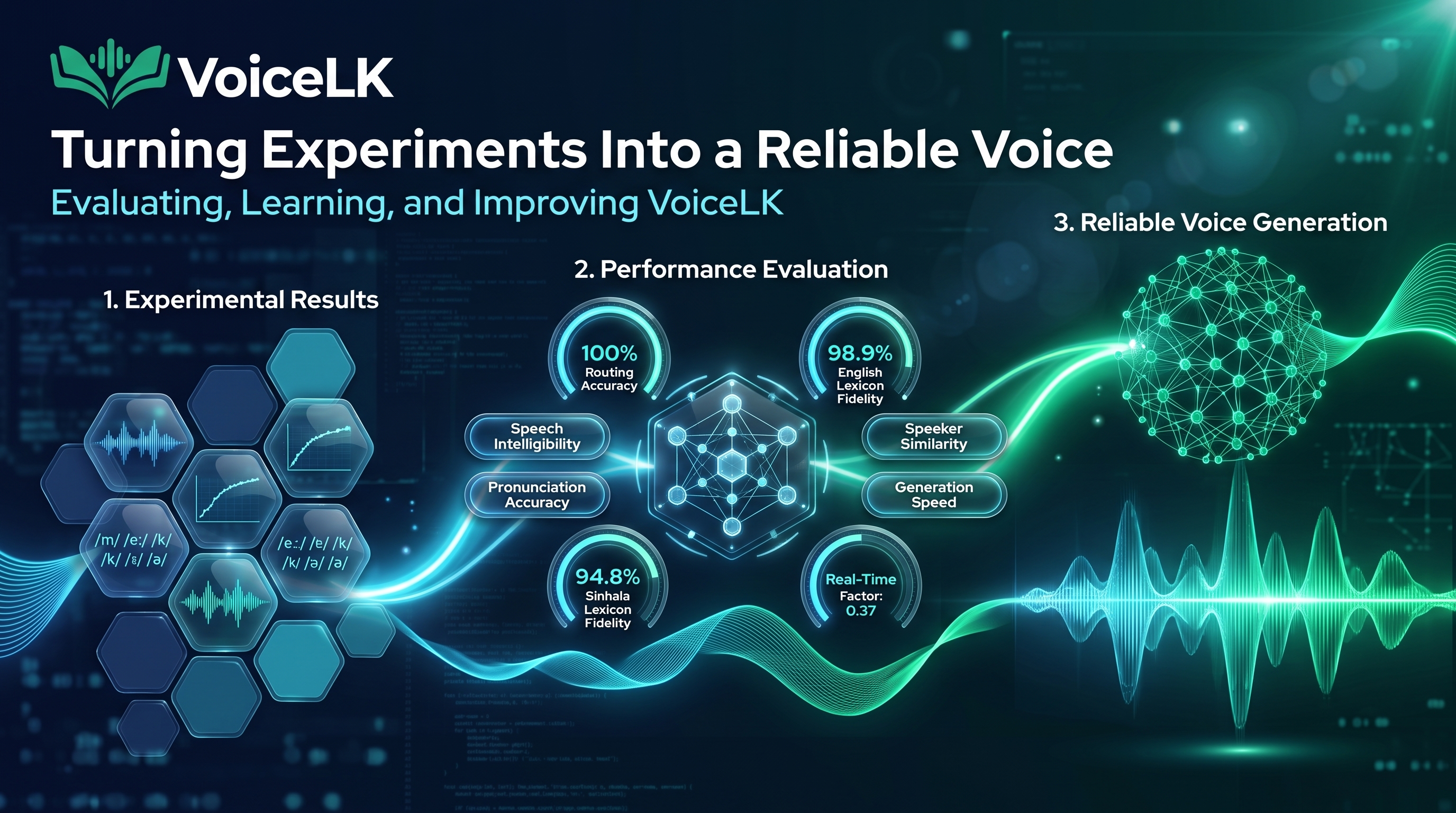
We also evaluated pronunciation handling and vocabulary coverage. The custom language-processing pipeline achieved 100% routing accuracy on 22 test tokens, while lexicon fidelity reached 98.9% for English and 94.8% for Sinhala in the reported evaluation.
Another encouraging result was speaker similarity. The model achieved a reported score of 0.869, compared with 0.859 for the real-speaker reference. The model also achieved a CPU real-time factor of 0.37, indicating that speech generation could run faster than the duration of the generated audio under the tested conditions.
These results helped us assess VoiceLK from several perspectives: language routing, pronunciation, intelligibility, speaker similarity, and generation speed. Each measurement provided different information about the system's performance.
However, we recognised that good experimental results do not eliminate every limitation. Further testing and human evaluation are still important for understanding how listeners perceive the generated voices across different sentences and speaking contexts.
Reliability comes from measuring performance, learning from results, and improving the system step by step. These experiments helped us move VoiceLK closer to a practical Sinhala–English text-to-speech application.